
As Amazon Associates, we earn from qualifying purchases. This means we may receive a small commission at no extra cost to you if you click through and make a purchase.
Upgrading home networking hardware has reached a pivotal stage where standard dual-band routers struggle to keep pace with multi-gigabit residential broadband and dense device environments. Investing in a tp-link wifi 7 router introduces physical layer enhancements, such as Multi-Link Operation (MLO), Multi-Resource Units (Multi-RUs), and 4096-QAM modulation, designed to reduce latency and maintain high wireless capacity. Selecting the right setup requires balancing these high-throughput features against the actual physical requirements of your home network. Shoppers must primarily decide between dual-band access points engineered for everyday connected devices and tri-band platforms that unlock the low-interference 6 GHz spectrum for high-bandwidth client hardware.
The current range of wifi 7 tp link products is structured around distinct performance tiers, primarily distinguished by frequency band architecture, Ethernet throughput capacity, and antenna layouts. From dual-band models like the Archer BE230 and BE400 to advanced tri-band flagships like the Archer BE550, Archer BE600, and Archer BE800, the lineup provides different pathways for users transitioning away from earlier standards or tp link 6e setups. Determining which tp-link wifi 7 router to buy depends on your internet tier, wired port requirements, and device count. A comprehensive tp-link wifi 7 router comparison helps match these hardware designs to your living space and daily online activities.
TP-Link WiFi 7 Routers Lineup at a Glance
| Model | Wireless Band Architecture | Total Wireless Speed | Ethernet Interfaces | Coverage & Devices |
|---|---|---|---|---|
| TP-Link Tri-Band BE9700 WiFi 7 Router (Archer BE600) | Tri-Band (6 GHz, 5 GHz, 2.4 GHz) | 9.7 Gbps | 1x 10 Gbps WAN/LAN, 1x 2.5 Gbps WAN/LAN, 3x 2.5 Gbps LAN | Up to 2,600 sq. ft., 120 devices |
| TP-Link BE6500 Dual-Band WiFi 7 Router (BE400) | Dual-Band (5 GHz, 2.4 GHz) | 6.5 Gbps | 1x 2.5 Gbps WAN/LAN, 1x 2.5 Gbps LAN, 3x 1 Gbps LAN | Up to 2,400 sq. ft., 90 devices |
| TP-Link Tri-Band BE9300 WiFi 7 Router (Archer BE550) | Tri-Band (6 GHz, 5 GHz, 2.4 GHz) | 9.2 Gbps | 1x 2.5 Gbps WAN, 4x 2.5 Gbps LAN | The listing does not specify |
| TP-Link Tri-Band BE19000 WiFi 7 Router (Archer BE800) | Tri-Band (6 GHz, 5 GHz, 2.4 GHz) | 19 Gbps | 2x 10 Gbps WAN/LAN (1x RJ45, 1x SFP+ combo), 4x 2.5 Gbps LAN | 8 internal antennas (sq. ft. not specified) |
| TP-Link Dual-Band BE3600 Wi-Fi 7 Router (Archer BE230) | Dual-Band (5 GHz, 2.4 GHz) | 3.6 Gbps | 1x 2.5 Gbps WAN/LAN, 1x 2.5 Gbps LAN, 3x 1 Gbps LAN | Up to 2,000 sq. ft., 60 devices |
The Models in Detail
TP-Link Tri-Band BE9700 WiFi 7 Router 7-Stream, BE9700 Tri-Band Wi-Fi 7 Speeds
Check price on Amazon Our score: 8.2/10
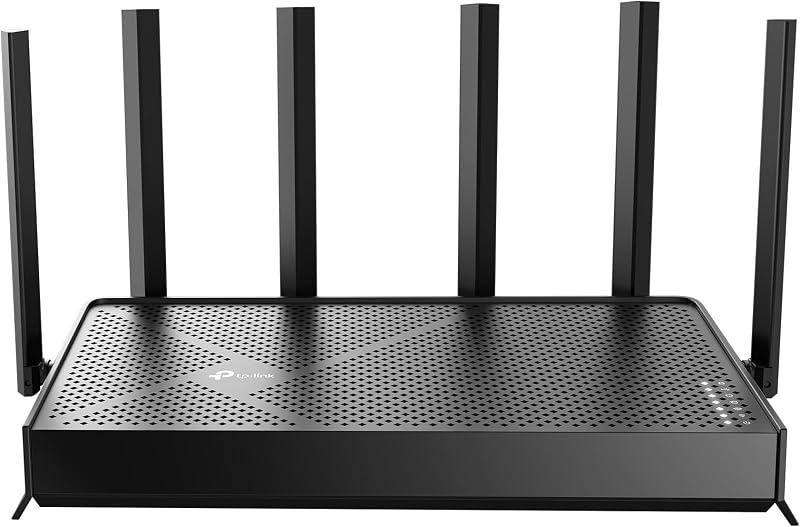
Best for: Large homes needing 10G wired speeds
Pros
- 10 Gbps WAN/LAN port
- Tri-band BE9700 with 320 MHz
- Covers up to 2,600 sq. ft
Cons
- Windows operating system listed
The TP-Link Tri-Band BE9700 WiFi 7 Router, designated in its specification documentation as the tp-link archer be600, provides high-throughput wireless networking across three distinct frequency channels. It achieves combined wireless rates up to 9.7 Gbps, distributed as 5,765 Mbps on the 6 GHz band, 2,882 Mbps on the 5 GHz band, and 1,032 Mbps on the 2.4 GHz band. Built with support for 320 MHz channels on the 6 GHz frequency, 4K-QAM, and Multi-Link Operation (MLO), it allows modern devices like the iPhone 16 Pro, Samsung Galaxy S24 Ultra, and PS5 Pro to combine bands into a single connection, cutting latency during gaming or streaming sessions.
Physical networking interfaces on this unit include one 10 Gbps WAN/LAN port, one 2.5 Gbps WAN/LAN port, and three 2.5 Gbps LAN ports, alongside a USB 3.0 port. This wired setup ensures local network transfers and incoming multi-gigabit broadband lines run without bottlenecking. Wireless transmission is supported by six internal antennas equipped with Beamforming technology, engineered to deliver reliable coverage across homes up to 2,600 square feet for as many as 120 concurrent devices.
Security and management run through TP-Link HomeShield, which includes real-time IoT protection, a private IoT network layer, and parental controls. TP-Link is a signatory of the CISA Secure-by-Design pledge, making advanced device protection a foundational feature. The Archer BE600 is well suited for modern households seeking high-speed 10G wired connectivity and 6 GHz spectrum. It hands off to the Archer BE800 if fiber optic SFP+ interfaces are needed, or to the Archer BE550 if a fully dedicated 2.5G port array is preferred over a single 10G port.
TP-Link BE6500 Dual-Band WiFi 7 Router 6-Stream, Dual-Band Wi-Fi with 6.5 Gbps Total Bandwidth
Check price on Amazon Our score: 9.4/10
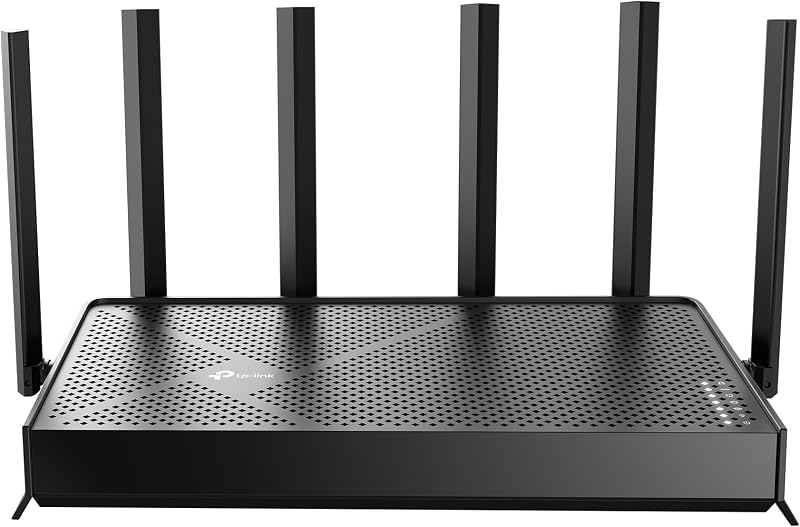
Best for: High-device households focusing on 5 GHz
Pros
- Dual 2.5 Gbps ports
- 5 Gbps dual-band bandwidth
- Connects up to 90 devices
Cons
- No 6 GHz band support
- Incompatible with Deco mesh
The TP-Link BE6500 Dual-Band WiFi 7 Router, listed as the tp-link be400, focuses its resources on high-density dual-band transmission. Delivering total bandwidth up to 6.5 Gbps across six spatial streams, it generates up to 5,764 Mbps on the 5 GHz band and 688 Mbps on the 2.4 GHz band. While it does not include 6 GHz wireless support, it integrates essential Wi-Fi 7 protocols, including Multi-Link Operation, 4K-QAM, and Multi-RUs, to optimize data delivery across multiple devices simultaneously.
Wired connectivity includes one 2.5 Gbps WAN/LAN port, one 2.5 Gbps LAN port, and three standard 1 Gbps LAN ports, in addition to an onboard USB port. Coverage reaches up to 2,400 square feet and accommodates up to 90 devices, utilizing six fixed external antennas and Beamforming to reinforce signal direction. The BE400 supports EasyMesh standard technology for network expansion, though the listing specifies that it is not compatible with proprietary mesh systems like a tp-link deco tri-band mesh system.
Software settings on the BE400 can be configured through the Tether app, offering guest networking, QoS, and parental controls under a Linux operating system. This model is suited for mid-sized homes with multi-gigabit internet plans that want lower latency across standard 5 GHz client hardware. For users seeking access to ultra-wide 320 MHz channels or the clear 6 GHz band, stepping up to the Archer BE550 or BE600 is the recommended direction.
TP-Link Tri-Band BE9300 WiFi 7 Router BE9300 Tri-Band Wi-Fi 7 Speeds
Check price on Amazon Our score: 8.0/10

Best for: All-2.5G wired networks requiring 6 GHz
Pros
- Five 2.5 Gbps Ethernet ports
- Tri-band BE9300 with 320 MHz
- Built-in VPN client and server
Cons
- Square footage coverage not specified
The TP-Link Tri-Band BE9300 WiFi 7 Router, cataloged as the tp-link archer be550, introduces tri-band operation with a unified multi-gigabit wired backplane. Operating with a cumulative data rate of 9.2 Gbps (marketed as BE9300), it provides 5,760 Mbps on the 6 GHz band, 2,880 Mbps on the 5 GHz band, and 574 Mbps on the 2.4 GHz band. The dedicated 6 GHz frequency enables 320 MHz channel widths to avoid signal congestion from older wireless devices.
The physical port layout features five 2.5 Gbps Ethernet interfaces, configured as one 2.5G WAN port and four 2.5G LAN ports, accompanied by a USB port. This architecture ensures high-speed data flow across all connected computers and storage drives. Six internal antennas combine with proprietary Wi-Fi optimization and Beamforming to distribute wireless signals. The router also includes native EasyMesh support to form whole-home wireless networks using compatible extenders.
The Archer BE550 includes integrated VPN Client and Server tools, enabling network-wide VPN routing without installing individual software packages on client devices. HomeShield tools and private IoT network isolation let you safely partition smart home accessories, including third-party hardware such as d link cameras wifi, away from private data. This router suits households that need all-2.5G LAN ports alongside clear 6 GHz wireless channels, stepping aside for the Archer BE600 when a 10 Gbps wired port is needed.
TP-Link Tri-Band BE19000 WiFi 7 Router Wi-Fi 7 Router with Wired Connectivity and LED Display Features Wi-Fi 7
Check price on Amazon Our score: 8.8/10

Best for: Prosumers demanding 10G fiber uplinks
Pros
- Dual 10G ports with SFP+ fiber
- 19 Gbps tri-band bandwidth
- Integrated front LED display
Cons
- Square footage coverage not specified
The TP-Link Tri-Band BE19000 WiFi 7 Router, known as the tp-link archer be800, sits at the top of the lineup for raw throughput and physical interface capacity. It delivers an aggregate wireless speed of up to 19 Gbps across its tri-band configuration, distributing up to 11,520 Mbps on the 6 GHz channel, 5,760 Mbps on the 5 GHz channel, and 1,376 Mbps on the 2.4 GHz channel. The chassis features a modern upright profile that integrates an active LED display on the front face.
Physical connectivity includes dual pro-grade 10 Gbps WAN/LAN ports: one standard RJ45 port and one SFP+ Fiber/RJ45 Ethernet combo port. This design permits direct fiber connections or high-speed copper lines, supported by four 2.5 Gbps LAN ports and a USB 3.0 interface. Eight internal antennas with Beamforming provide extensive directional signal coverage, while Wi-Fi 7 features like 320 MHz channels, Multi-RUs, and MLO ensure low-latency packet delivery.
Running on RouterOS, the BE800 offers extensive management tools, including HomeShield network scanning, basic parental controls, QoS, and concurrent VPN client and server functions. It also integrates EasyMesh compatibility for seamless roaming. The Archer BE800 is built for demanding home studios, homelab setups, and workstation networks requiring 10G backhaul links. For standard residential setups without 10 Gbps hardware, the Archer BE600 or BE550 provides a more practical tri-band option.
TP-Link Dual-Band BE3600 Wi-Fi 7 Router Future-Proof Your Home With Wi-Fi 7
Check price on Amazon Our score: 8.4/10
Best for: Apartments wanting entry multi-gig Wi-Fi 7
Pros
- Dual 2.5 Gbps Ethernet ports
- 0 GHz quad-core processor
- Covers up to 2,000 sq. ft
Cons
- No 6 GHz band support
- Lower 3.6 Gbps total bandwidth
The TP-Link Dual-Band BE3600 Wi-Fi 7 Router, documented as the tp-link archer be230, serves as the compact entry point to the brand’s Wi-Fi 7 hardware line. It delivers combined dual-band wireless speeds of up to 3.6 Gbps, providing up to 2,882 Mbps on the 5 GHz band and 688 Mbps on the 2.4 GHz band. Because it is a dual-band router, it does not support the 6 GHz band, but it utilizes Multi-Link Operation, 4K-QAM, and Multi-RUs to improve connection efficiency on supported devices.
Internally, the BE230 is powered by a 2.0 GHz quad-core processor designed to manage high data throughput and reduce latency during concurrent downloads and streaming. The wired connectivity array consists of one 2.5 Gbps WAN/LAN port, one 2.5 Gbps LAN port, and three 1 Gbps LAN ports, alongside a USB port. Four internal antennas paired with Beamforming cover areas up to 2,000 square feet for up to 60 connected client devices.
Network security is provided by TP-Link HomeShield, offering basic parental controls, guest network modes, and WPA3 security protocols. EasyMesh compatibility allows this unit to connect with compatible extenders to expand coverage across larger spaces. The Archer BE230 is an effective choice for apartments and modest single-story homes with internet plans reaching over 1 Gbps. It hands off to the BE400 when higher 5 GHz throughput is required, or to the Archer BE550 when a dedicated 6 GHz wireless frequency is desired.
Matching a Model to Your Setup
- Homelabs and 10G Fiber Internet Connections: The TP-Link Tri-Band BE19000 WiFi 7 Router (Archer BE800) matches setups that require pro-grade dual 10 Gbps ports, SFP+ fiber integration, and massive 19 Gbps tri-band bandwidth.
- High-Speed Multi-Gig Homes Needing 6 GHz and 10G LAN: The TP-Link Tri-Band BE9700 WiFi 7 Router (Archer BE600) fits households with multi-gig broadband that need a 10 Gbps port, three 2.5G ports, and 320 MHz channels across up to 2,600 square feet.
- Full 2.5G Local Networks and Dedicated VR Gaming: The TP-Link Tri-Band BE9300 WiFi 7 Router (Archer BE550) works well for homes where every wired device utilizes a 2.5 Gbps port, paired with a dedicated 6 GHz band for clean wireless gaming.
- Multi-Device Streaming Without 6 GHz Hardware: The TP-Link BE6500 Dual-Band WiFi 7 Router (BE400) is built for families with up to 90 devices needing fast 6-stream 5 GHz transmission and dual 2.5 Gbps ports.
- Apartments and Moderate Networks on Multi-Gig Tiers: The TP-Link Dual-Band BE3600 Wi-Fi 7 Router (Archer BE230) provides a 2.0 GHz quad-core CPU and dual 2.5G ports for spaces up to 2,000 square feet and 60 devices.
Before You Buy
Before purchasing a Wi-Fi 7 router, confirm your existing modem and broadband setup. The product listings specify that all of these Wi-Fi routers require a separate modem or optical network terminal (ONT) provided by your internet service provider. In addition, taking full advantage of Wi-Fi 7 features, such as 320 MHz channel widths, 4K-QAM, and Multi-Link Operation, requires client devices with compatible Wi-Fi 7 hardware. While standard Wi-Fi 6, 6E, and older devices will connect without issue, their performance will remain limited by their native hardware standards.
Coverage specifications and system compatibility also vary across the portfolio. The manufacturer lists explicit coverage boundaries for the Archer BE600 (up to 2,600 sq. ft. and 120 devices), the BE400 (up to 2,400 sq. ft. and 90 devices), and the Archer BE230 (up to 2,000 sq. ft. and 60 devices), while the listing does not specify explicit square footage or device maximums for the Archer BE550 and Archer BE800. Furthermore, while these models support EasyMesh expansion, the product data explicitly notes that they are not compatible with Deco mesh systems.
FAQ
What is the main difference between dual-band and tri-band TP-Link WiFi 7 routers?
Dual-band models, such as the Archer BE230 and BE400, broadcast across the 2.4 GHz and 5 GHz frequency bands. Tri-band routers, including the Archer BE550, Archer BE600, and Archer BE800, add a third 6 GHz wireless frequency. The 6 GHz band provides access to ultra-wide 320 MHz channels and remains free from legacy wireless interference, allowing higher throughput on compatible devices.
Do these TP-Link WiFi 7 routers work with Deco mesh systems?
No. TP-Link states in its product listings that EasyMesh-compatible Archer routers do not integrate into Deco mesh systems. To expand coverage with these routers, you must pair them with EasyMesh-compatible routers, range extenders, or wireless powerline adapters rather than Deco units.
What internet speeds do the Ethernet ports support across this lineup?
The port configurations vary across tiers. The Archer BE230 and BE400 feature two 2.5 Gbps ports (one WAN/LAN, one LAN) alongside three 1 Gbps LAN ports. The Archer BE550 provides five 2.5 Gbps ports (one WAN, four LAN). The Archer BE600 includes one 10 Gbps WAN/LAN port, one 2.5 Gbps WAN/LAN port, and three 2.5 Gbps LAN ports. The Archer BE800 includes two 10 Gbps WAN/LAN ports (one RJ45, one SFP+ combo) and four 2.5 Gbps ports.
Can I use VPN client functions directly on these routers?
Yes, selected models provide native VPN client capabilities. The product listings for the Archer BE550 and Archer BE800 state support for both VPN Client and VPN Server operations. This enables connected home hardware to access remote VPN tunnels directly without installing VPN software on each device.
Do TP-Link WiFi 7 routers include a built-in modem?
No. None of the routers in this lineup include an integrated modem. Every model must be connected via an Ethernet cable or fiber line to a standalone cable modem, DSL modem, or fiber ONT provided by your ISP.