
As Amazon Associates, we earn from qualifying purchases. This means we may receive a small commission at no extra cost to you if you click through and make a purchase.
Selecting among westinghouse generators for home use requires balancing essential circuits against engine output and fuel choice. During an outage, a homeowner must decide between powering basic appliances like refrigerators and sump pumps or supporting heavy 240V equipment like well pumps and central air conditioning. Choosing a dual fuel home backup generator or a tri-fuel model provides critical flexibility, letting you keep vital home systems running whether using portable fuel tanks or residential utility gas lines.
The manufacturer organizes its lineup across distinct wattage tiers and engine sizes, ranging from compact 274cc models to heavy-duty 999cc V-Twin platforms. Each tier incorporates features designed for residential connection, including carbon monoxide monitoring, automatic voltage regulation, digital hour meters, and transfer-switch-ready receptacles. Navigating a westinghouse home backup generators comparison helps clarify how running wattages adjust across gasoline, propane, and natural gas feeds, ensuring buyers understand which westinghouse home backup generators to buy for their home breaker panel and daily routine.
Westinghouse Home Backup Generators Lineup at a Glance
| Model | Running / Peak Watts (Gas) | Fuel Type | Outlets |
|---|---|---|---|
| Westinghouse 12500 Watt Dual Fuel Home | 9,500W / 12,500W | Gasoline, Propane | L14-30R 30A, 14-50R 50A, 5-20R GFCI |
| Westinghouse 14500 Peak Watt Tri-Fuel Home | 11,500W / 14,500W | Gasoline, Propane, Natural Gas | 240V Outlets, GFCI Duplex Receptacles |
| Westinghouse 13500 Peak Watt Dual Fuel | 10,500W / 13,500W | Gasoline, Propane | L14-30R 30A, 14-50R 50A, USB, 5-20R |
| Westinghouse 6500 Watt Dual Fuel Home | 5,300W / 6,500W | Gasoline, Propane | L14-30R 30A, TT-30R RV, 5-20R Duplex |
| Westinghouse 6600 Peak Watt Home Backup | 5,300W / 6,600W | Gasoline | L14-30R 30A, TT-30R RV, 5-20R Duplex |
| Westinghouse 28000 Peak Watt Tri-Fuel Home | 20,000W / 28,000W | Gasoline, Propane, Natural Gas | 125A Terminal Block, Dual 50A, Dual 30A |
The Models in Detail
Westinghouse 12500 Watt Dual Fuel Home 9500 Running Watts and 12500 Peak Watts (Gasoline)
Check price on Amazon Our score: 8.4/10

Best for: Suburban homes needing push-button dual fuel backup
Pros
- Remote start key fob included
- Dual fuel gas and propane operation
- Transfer switch ready 30A outlet
Cons
- Lower peak output on propane
The Westinghouse 12500 Watt Dual Fuel Home generator produces 9,500 running watts and 12,500 peak watts on gasoline, or 8,500 running watts and 11,200 peak watts on propane. Powered by a 457cc 4-stroke OHV engine with a cast iron sleeve, it runs up to 12 hours on a 6.6-gallon fuel tank with a built-in fuel gauge. The panel features two GFCI 120V 5-20R duplex receptacles, one 120V L14-30R 30A transfer switch outlet, and one 120/240V 14-50R 50A outlet, all protected by rubber covers. A digital VFT meter tracks output voltage, frequency, and lifetime operating hours in real time.
This westinghouse 12500 watt dual fuel unit is built for suburban homeowners needing substantial wattage without manual pull-start strain, thanks to electric push-button ignition and an included remote key fob. While an indoor power station like an anker generator for home setup handles small electronics, this machine powers inductive loads like deep well pumps and sump pumps. It includes engine oil, a funnel, a 12V charger, and a tool kit. It suits homes connecting to a 30A or 50A inlet box, giving way to tri-fuel models when natural gas plumbing is preferred.
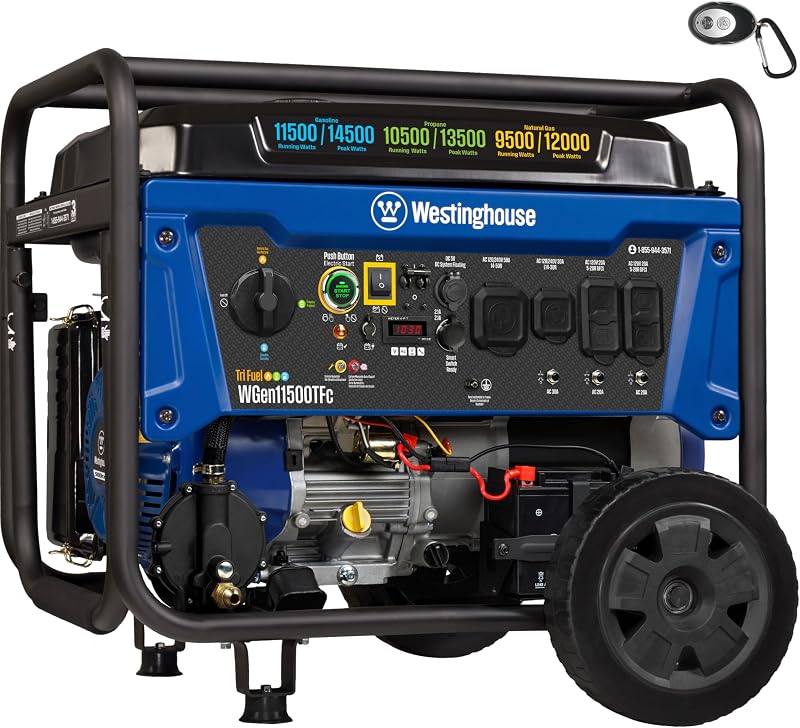
Westinghouse 14500 Peak Watt Tri-Fuel Home 14,500 peak watts, 11,500 running watts (gasoline)
Check price on Amazon Our score: 8.6/10
Best for: Homes with natural gas seeking clean power
Pros
- Tri-fuel natural gas compatibility
- Clean power under 5 percent THD
- Up to 19 hours gasoline runtime
Cons
- Large 550cc engine weight
The Westinghouse 14500 Peak Watt Tri-Fuel Home generator delivers versatile tri-fuel performance driven by a 550cc 4-stroke OHV engine. On gasoline, it outputs 11,500 running watts and 14,500 peak watts with up to 19 hours of runtime on a 9.5-gallon tank. Propane produces 10,500 running watts and 13,500 peak watts, running up to 7 hours on a 20-pound cylinder, while utility natural gas yields 9,500 running watts and 12,000 peak watts. Built-in safety features include an automatic carbon monoxide shutdown sensor, automatic voltage regulation, and an electric start system.
Engineered with copper windings producing less than 5 percent total harmonic distortion, this westinghouse 14500 tri-fuel machine safely runs sensitive electronics such as computers, networking gear, and televisions during outages. While reviewing a traditional gasoline honda generator demonstrates standard single-fuel operation, this tri-fuel generator allows homeowners to connect directly to an outdoor natural gas line to avoid liquid fuel storage entirely. It suits larger homes managing continuous refrigeration, heating controls, and branch circuits during extended storms.
Westinghouse 13500 Peak Watt Dual Fuel 13500 Peak Watts, 10500 Running Watts (Gasoline)
Check price on Amazon Our score: 9.6/10

Best for: Heavy emergency circuits requiring dual fuel capacity
Pros
- 10500 running watts on gasoline
- Carbon monoxide safety sensor shutdown
- Onboard USB charging port
Cons
- Reduced running wattage on propane
The Westinghouse 13500 Peak Watt Dual Fuel generator produces 10,500 running watts and 13,500 peak watts on gasoline, alongside 9,500 running watts and 12,500 peak watts on propane. It utilizes a 500cc 4-stroke OHV engine equipped with low oil shutdown, carbon monoxide monitoring, and a digital hour meter. Its 9.5-gallon fuel tank delivers up to 19 hours of run time. The control panel includes two GFCI 120V 5-20R duplex receptacles, a 120V L14-30R 30A outlet, a 120/240V 14-50R 50A outlet, and a built-in USB port.
Operation is handled through push-button electric start, an included remote key fob, or a manual recoil backup. For homeowners comparing engine generators to portable battery units like an eco flo generator, this dual-fuel platform delivers the continuous wattage required for heavy 240V appliances that battery packs cannot sustain. It fits households that need more power than standard 9,500-watt models provide, but do not require natural gas plumbing. It steps aside for the 28,000-watt unit when full-home panel hardwiring is necessary.
Westinghouse 6500 Watt Dual Fuel Home 5300 Running Watts & 6500 Peak Watts
Check price on Amazon Our score: 8.8/10

Best for: Essential home circuits with dual fuel thrift
Pros
- Built-in carbon monoxide sensor
- 120V and 240V selector switch
- Propane regulator hose included
Cons
- Manual recoil start only
The Westinghouse 6500 Watt Dual Fuel Home generator provides 5,300 running watts and 6,500 peak watts on gasoline, with 4,800 running watts and 5,800 peak watts on liquid propane. Driven by a 274cc 4-stroke OHV engine, it runs for up to 14.5 hours on a 4.7-gallon fuel tank. It features a 120/240V volt selector switch to optimize power delivery between dedicated circuits. Outlets include one 120V 5-20R duplex receptacle, one RV-ready TT-30R 30A receptacle, and one transfer-switch-ready L14-30R 30A outlet.
This westinghouse 6500 watt generator includes a built-in carbon monoxide sensor that automatically shuts off the engine if hazardous fumes build up. The unit ships with an oil funnel, engine oil, a propane regulator hose, a tool kit, and a wheel kit for easy setup. It is tailored for homeowners who need to back up essential household circuits—like a refrigerator, gas furnace blower, and sump pump—while conserving fuel. It gives way to the 12,500-watt model when high-draw electric water heaters or well pumps must run.
Westinghouse 6600 Peak Watt Home Backup 5300 Running Watts and 6600 Peak Watts
Check price on Amazon Our score: 8.0/10
Best for: Basic outage circuits on pure gasoline
Pros
- Transfer switch ready 30A outlet
- Digital hour meter tracking
- Carbon monoxide automatic shutdown
Cons
- Gasoline only operation
The Westinghouse 6600 Peak Watt Home Backup generator generates 5,300 running watts and 6,600 peak watts from a single-fuel gasoline system. Powered by a 274cc 4-stroke OHV engine with a cast iron sleeve and manual recoil start, it operates for up to 14.5 hours on a 4.7-gallon fuel tank with a built-in mechanical fuel gauge. It includes an automatic carbon monoxide safety sensor, low oil shutdown, overload protection, and a digital hour meter.
The control panel features a 120/240V selector switch, one 120V 20A duplex outlet, one RV-ready TT-30R 30A receptacle, and one L14-30R 30A transfer switch connection with protective rubber covers. While examining higher output options like a westinghouse 15000 watt generator helps when planning full-panel loads, this generator suits modest emergency setups relying on gasoline. It is best for budget-focused homeowners who want transfer-switch compatibility for essential circuits without the added complexity of dual-fuel plumbing.
Westinghouse 28000 Peak Watt Tri-Fuel Home Two 120/240V 14-50R 50A outlets, two 120/240V L14-30R 30A outlets, all
Check price on Amazon Our score: 9.8/10
Best for: Whole-home backup running central air conditioners
Pros
- Massive 20000 running watts on gasoline
- Exclusive 125A 240V terminal block
- Tri-fuel natural gas flexibility
Cons
- Heavy frame requiring large storage footprint
The Westinghouse 28000 Peak Watt Tri-Fuel Home generator is powered by a heavy-duty 999cc 4-stroke OHV V-Twin engine. On gasoline, it produces 20,000 running watts and 28,000 peak watts, running up to 15 hours at 25 percent load on a 17.2-gallon fuel tank. Propane delivers 18,000 running watts and 25,200 peak watts, while natural gas produces 16,000 running watts and 22,400 peak watts. Copper alternator windings maintain under 5 percent total harmonic distortion for clean power across residential circuits.
For whole-home backup, this westinghouse 28000 peak watt platform features an exclusive 125A 240V AC terminal block, allowing a licensed electrician to hardwire the generator directly to your home panel. It also includes two 14-50R 50A outlets, two L14-30R 30A outlets, an L5-30R 30A outlet, four GFCI 5-20R duplex outlets, remote key fob start, automatic idle control, and a carbon monoxide sensor. It is intended for large homes with multiple central air conditioners and heavy appliances that require whole-house power without circuit compromises.
Matching a Model to Your Setup
- Suburban homes with natural gas lines: The Westinghouse 14500 Peak Watt Tri-Fuel Home connects directly to your residential gas utility, ensuring continuous power without needing liquid fuel storage during winter storms.
- Homes with deep well pumps and propane tanks: The Westinghouse 12500 Watt Dual Fuel Home provides the high starting surge required for pump motors, running reliably on shelf-stable propane cylinders.
- Large estates requiring whole-house coverage: The Westinghouse 28000 Peak Watt Tri-Fuel Home utilizes its 125A terminal block and 999cc V-Twin engine to run central air conditioners and multiple heavy circuits simultaneously.
- Compact homes with a 30-amp transfer switch: The Westinghouse 6500 Watt Dual Fuel Home efficiently powers refrigerators, lighting, and furnace blowers through its L14-30R outlet with low fuel consumption.
- Simple backup using gasoline only: The Westinghouse 6600 Peak Watt Home Backup delivers recoil-start reliability and 5,300 running watts for essential household branch circuits.
- Heavy dual-fuel demands without natural gas: The Westinghouse 13500 Peak Watt Dual Fuel offers 10,500 running watts and a 9.5-gallon fuel tank for high-draw subpanels.
Before You Buy
Before selecting a generator, note what is not included in the factory packaging. While Westinghouse provides engine oil, an oil funnel, tool kits, and propane regulator hoses on applicable models, the listings do not specify or include manual transfer switches, interlock kits, or power inlet boxes. Connecting any portable generator safely to a residential service panel requires a certified transfer switch or mechanical interlock installed by a licensed electrician to prevent dangerous electrical backfeeding into the utility grid. Additionally, while the tri-fuel generators support natural gas, the listings do not include natural gas quick-connect plumbing lines or shutoff valves, which must be installed to local code.
Operating wattage also depends heavily on the fuel source in use. Gasoline delivers the full rated nameplate wattage, whereas propane and natural gas yield slightly reduced running and peak wattage due to differing energy densities. You must also account for inductive motor starting surges when calculating circuit requirements. Be aware that running high-capacity models through a standard 30-amp receptacle caps power delivery at 7,200 watts, requiring a 50-amp cord or terminal hardwiring to access full machine output.
FAQ
Can Westinghouse home backup generators safely power sensitive electronics?
The Westinghouse 14500 Peak Watt Tri-Fuel Home and Westinghouse 28000 Peak Watt Tri-Fuel Home feature durable copper windings that keep total harmonic distortion under 5 percent. This clean sine wave power is safe for sensitive electronics like desktop computers, network hardware, and televisions.
Which Westinghouse home backup generators to buy for a standard 30-amp inlet box?
The Westinghouse 6500 Watt Dual Fuel Home and Westinghouse 6600 Peak Watt Home Backup match 30-amp inlet boxes perfectly. Both feature an L14-30R outlet with a 120/240V selector switch, supplying full generator capacity without exceeding 30-amp limits.
What are the best Westinghouse home backup generators for central air conditioning?
The Westinghouse 28000 Peak Watt Tri-Fuel Home is the most capable model for central air conditioning, offering 20,000 running watts and an exclusive 125A hardwire terminal block that handles the massive starting surge of large cooling compressors.
Why do new Westinghouse generators sometimes smell of fuel or oil out of the box?
Every Westinghouse portable generator is functionally tested at the factory before boxing to verify engine performance and electrical output. This process can leave minor residual oil or a faint fuel odor in the packaging, which is normal.
How does a dual fuel home backup generator help during extended outages?
A dual fuel generator runs on gasoline or propane. Propane stores indefinitely without going stale or gumming up engine carburetors, giving homeowners a dependable fuel backup when local gasoline stations lose power during severe storms.