As Amazon Associates, we earn from qualifying purchases. This means we may receive a small commission at no extra cost to you if you click through and make a purchase.
Choosing an emergency power supply requires balancing total household electrical loads against the fuel reserves you can realistically store and maintain during extended outages. While gasoline remains common, it degrades rapidly in storage and requires regular stabilizer treatments, while propane tanks can be cumbersome to restock during widespread emergencies. Piped natural gas offers an essentially uninterrupted fuel supply directly from municipal infrastructure, which is why tri-fuel technology has emerged as a cornerstone of modern residential resilience. When evaluating equipment, calculating your home’s total electrical footprint involves reviewing both running watts and the high surge demands created when motor-driven appliances cycle on, all while recognizing that power generation capacities vary significantly depending on whether you connect to natural gas, propane, or gasoline.
The Champion catalog structures its residential backup lineup around varying household scales, starting with heavy-duty multi-fuel units and extending to smaller portable inverters. The flagship open-frame generators feature dedicated tri-fuel systems engineered to switch between natural gas, liquid petroleum gas, and gasoline via manual selection dials, complete with factory-supplied fuel hoses. In contrast, the company provides dual-fuel platforms that eliminate the natural gas intake entirely, providing optimized gasoline and liquid propane operation for situations where municipal lines do not exist or where high portability takes priority. Understanding how these mechanical configurations align with appliance loads, breaker panels, and plumbing connections will help you select the exact capacity necessary to keep your property functioning smoothly during a blackout.
Champion Tri Fuel Generators Lineup at a Glance
| Model | Fuel Capability | Gasoline Output (Start / Run) | Engine Displacement | Key Technical Feature |
|---|---|---|---|---|
| Champion 12,500-Watt Electric Start Tri Fuel | Natural Gas, Propane, Gasoline | 12,500W / 10,000W | 500cc | CO Shield, Intelligauge, Rocker Switch Start |
| Champion 8125-Watt Electric Start Tri Fuel | Natural Gas, Propane, Gasoline | 8,125W / 6,500W | 389cc | CO Shield, 4-Stroke OHV, Compact Frame |
| Champion 16,875-Watt Electric Start Tri Fuel | Natural Gas, Propane, Gasoline | 16,875W / 13,500W | 739cc V-Twin | Power Meter Intelligauge, Cold Start, 6 Outlets |
| Champion 4000-Watt Dual Fuel RV Ready | Propane, Gasoline | 4,000W / 3,000W | 149cc | Clean Power (under 3% THD), Parallel Ready |
| Champion 11,500-Watt Electric Start Dual Fuel | Propane, Gasoline | 11,500W / 9,200W | 459cc | Volt Guard Protection, Rocker Switch Start |
The Models in Detail
Champion 12,500-Watt Electric Start Tri Fuel Power up the 500cc Champion engine with the handy rocker switch, battery
Check price on Amazon Our score: 9.6/10

Best for: Homes with standard residential natural gas lines
Pros
- Tri-fuel operation right out of box
- Natural gas and propane hoses included
- Electric start rocker switch with battery
- Intelligauge runtime and voltage monitoring
Cons
- Wattage decreases when burning natural gas
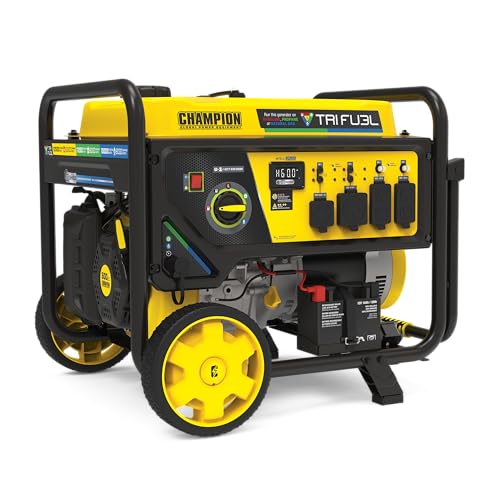
The Champion 12,500-Watt Electric Start Tri Fuel serves as a comprehensive electrical anchor for suburban homes equipped with standard natural gas utility lines. Built around a 500cc internal combustion engine, this unit delivers 12,500 starting watts and 10,000 running watts when fueled by gasoline. When transitioned to liquid propane, output shifts to 11,250 starting watts and 9,000 running watts, while a direct natural gas connection produces 10,000 starting watts and 8,000 running watts. This output makes it a practical champion home backup generator capable of energizing critical household circuits, including central heating blowers, sump pumps, full-sized refrigeration, and kitchen appliances, without constantly overloading the system.
Operation is managed through an integrated fuel select dial that allows users to swap between gasoline, liquid petroleum gas, and natural gas lines safely. The unit includes both natural gas and propane connection hoses directly in the carton alongside the required engine oil, expediting the initial installation process. Starting the 500cc motor requires pressing a battery-powered rocker switch, while the onboard Intelligauge tracks alternating current voltage, operational frequency, single-session run times, and cumulative engine hours to maintain strict maintenance schedules. Safety monitoring is handled by the CO Shield system, which automatically shuts down the generator if harmful carbon monoxide levels accumulate in the immediate area. The 29.17-liter fuel tank and automatic voltage regulation keep electrical output consistent across four onboard power receptacles.
This model is ideal for typical single-family households seeking substantial power without the mechanical complexity of industrial machinery. It bridges the gap between smaller emergency units and oversized commercial plants. However, if your home features multiple high-tonnage central air conditioning units alongside heavy electric heat strips, this unit gives way to the larger 16,875-watt tri-fuel platform, which supplies the added starting headroom demanded by multiple high-draw compressor motors.
Champion 8125-Watt Electric Start Tri Fuel Your 6500-watt portable generator operates on natural gas, propane, or
Check price on Amazon Our score: 8.6/10

Best for: Smaller properties managing essential household circuits
Pros
- Natural gas and propane connection ready
- Electric start 389cc 4-stroke engine
- Engine oil and hoses included in carton
Cons
- Only three total power outlets
- Reduced 5500W natural gas running output
The Champion 8125-Watt Electric Start Tri Fuel is engineered for property owners who prioritize targeted essential-circuit coverage on a manageable fuel footprint. Driven by a 389cc 4-stroke engine, this model generates 8,125 starting watts and 6,500 running watts on standard gasoline. Running the generator on liquid propane provides 7,500 starting watts and 6,000 running watts, while running on residential natural gas produces 6,875 starting watts and 5,500 running watts. This wattage spectrum accommodates critical infrastructure such as water well pumps, dedicated refrigeration units, home networking gear, and interior lighting grids during utility disruptions.
Similar to its larger siblings, the unit features an electric start rocker switch powered by an onboard battery, eliminating the physical exertion of manual recoil cords during adverse weather. A multi-position fuel select dial regulates fuel delivery, and the manufacturer includes both natural gas and propane hoses alongside engine oil in the box. Electrical output is monitored through an Intelligauge digital display that tracks runtime intervals, line frequency, and voltage. Integrated CO Shield carbon monoxide detection monitors the machine’s surroundings, disabling engine ignition if gas concentrations reach dangerous thresholds. The physical layout includes three power outlets and an 8.5-gallon gasoline reservoir, providing extended operational spans between refueling stops when natural gas lines are unavailable.
This unit is specifically tailored for budget-conscious homeowners or smaller residences where electrical panels can be divided to power only mandatory essentials. It serves as an accessible entry point in any comprehensive champion generator comparison. When electrical requirements expand to simultaneous high-draw loads—such as water heaters, electric ranges, and high-capacity HVAC systems—the champion 8125 watt tri fuel steps aside in favor of the 12,500-watt model, which provides the higher continuous amperage necessary to avoid selective load shedding.
Champion 16,875-Watt Electric Start Tri Fuel Operates on natural gas, propane, or gasoline, with hoses included for
Check price on Amazon Our score: 9.0/10

Best for: Large estates requiring high continuous emergency wattage
Pros
- High 13500W running capacity on gasoline
- 739cc Milwaukee Series V-Twin engine
- Extended 25-foot natural gas hose included
- Six total power outlets on panel
Cons
- Noticeable 79 dBA noise level
- Large 11-gallon fuel tank footprint
The Champion 16,875-Watt Electric Start Tri Fuel represents the upper boundary of portable residential power within the brand’s catalog. Powered by a heavy-duty 739cc Milwaukee Series V-Twin engine, this generator delivers 16,875 starting watts and 13,500 running watts on gasoline, offering sufficient capacity to manage whole-house electrical distribution through a heavy-duty manual transfer switch. Operating on an 11-gallon gasoline tank provides up to 8 hours of continuous run time under moderate loading, while generating an operating noise profile of 79 dBA measured from 23 feet. The package includes an extended 25-foot natural gas line hose and a 6.6-foot propane hose to facilitate secure positioning away from home foundations.
This high-output platform includes advanced engine management features such as Cold Start Technology, which regulates ignition and fuel-air mixture during freezing winter emergencies. The Intelligauge display on this flagship variant is upgraded with an active Power Meter, allowing users to visually monitor real-time electrical demand against maximum machine capacity alongside voltage and maintenance intervals. Operator safety remains anchored by the CO Shield automatic shutoff sensor. Power delivery is distributed across six individual power outlets, accommodating heavy 240-volt home backup connections alongside standard utility lines for high-amperage power tools or external equipment.
Homeowners managing expansive properties, rural facilities, or households with comprehensive luxury infrastructure will find this champion 16875 watt tri fuel model built to handle their full electrical capacity. It eliminates the need to choose between running climate control systems and powering household kitchen appliances. However, for properties with lower overall consumption or those without space to store a machine of this scale, the unit yields to the champion 12500 watt tri fuel, which offers easier maneuverability and lower continuous fuel consumption.
Champion 4000-Watt Dual Fuel RV Ready Operate your 4000-watt portable generator right out of the box on either
Check price on Amazon Our score: 9.2/10

Best for: RV camping and delicate home electronics
Pros
- Clean power under 3 percent THD
- Ultra-quiet 64 dBA operation
- Lightweight design under 55 pounds
- Parallel ready for paired expansion
Cons
- Manual recoil pull start only
- No natural gas fuel compatibility
The Champion 4000-Watt Dual Fuel RV Ready diverges from large open-frame home backup generators by providing a lightweight, portable inverter architecture. Powered by a compact 149cc 4-stroke engine, this model is built for recreational vehicles, field setups, and modest residential emergency support. It produces 4,000 starting watts and 3,000 running watts on gasoline with a continuous run time of up to 10 hours on a modest 1.54-gallon fuel tank. When operated on propane, it supplies 2,700 running watts and achieves operational durations reaching up to 25 hours from a standard cylinder. Weighing under 55 pounds, it can be transported by a single person.
Engineered with an enclosed casing that maintains sound levels at a quiet 64 dBA from 23 feet, this inverter is designed to produce clean electricity with less than 3% total harmonic distortion (THD). This pure electrical waveform protects sensitive computer hardware, variable-speed furnace controls, and modern home electronics from electrical clipping and noise. The unit utilizes an EZ Start Dial and manual recoil pull system paired with Cold Start Technology for winter operation. Outlets include a 120V 25A TT-30R connection, a standard 120V 20A household duplex outlet, a 12V automotive port, and dedicated parallel outlets that allow users to link a second compatible inverter or portable setup, as detailed in our guide to the champion power station line.
This dual-fuel inverter is best suited for apartment dwellers, RV owners, or homeowners who only need to keep basic communication equipment, laptops, and a small refrigerator running during short blackouts. Because it relies exclusively on liquid propane and gasoline, it does not connect to municipal natural gas lines. If your home backup strategy relies on hardwiring directly into an emergency subpanel to run 240-volt well pumps or central cooling, this small inverter yields immediately to the heavy-duty tri-fuel lineup.
Champion 11,500-Watt Electric Start Dual Fuel Operate your 9200-watt portable generator right out of the box on either
Check price on Amazon Our score: 9.6/10
Best for: High-demand properties without municipal gas access
Pros
- Substantial 9200W gasoline running power
- Volt Guard voltage spike protection
- Wheel kit and battery included in box
Cons
- Heavy 209-pound overall weight
- Lacks natural gas fuel intake
The Champion 11,500-Watt Electric Start Dual Fuel provides high-wattage open-frame performance for locations where residential natural gas lines are unavailable. Equipped with a 459cc Champion engine, this dual-fuel workhorse delivers 11,500 starting watts and 9,200 running watts on gasoline, along with 10,350 starting watts and 8,280 running watts when powered by propane tanks. Designed for both residential and commercial job site environments, this model handles high starting currents from air compressors, well pumps, and heavy resistance heating coils without mechanical hesitation.
The control panel features an electric start rocker switch backed by an included starter battery, along with an intuitive Intelligauge tracking voltage, frequency, and operating hours. Internal components are safeguarded by Volt Guard, an integrated system designed to prevent electrical voltage spikes from damaging the generator or connected household appliances. The package includes a wheel kit to maneuver the 209-pound frame, an engine oil funnel, engine oil, and a dedicated propane connection hose. Built-in CO Shield monitors atmospheric safety, automatically shutting down the engine if carbon monoxide levels rise to dangerous thresholds.
This generator is ideal for rural homeowners, farm operators, and contractors who depend heavily on propane storage tanks or bulk gasoline reserves. When evaluating the broader champion global power generator catalog, this model stands out for its high continuous output. However, if your home has access to municipal natural gas infrastructure, selecting a champion tri fuel generator is generally preferable, as piped fuel eliminates the need to manage heavy propane tanks during severe winter storms.
Matching a Model to Your Setup
- Suburban homes with plumbed utility gas: The Champion 12,500-Watt Electric Start Tri Fuel connects straight to your home natural gas meter to maintain critical appliances without needing to store gasoline.
- Large multi-zone estates with central air conditioning: The Champion 16,875-Watt Electric Start Tri Fuel delivers the high running capacity and 240-volt output required to run whole-house electrical panels.
- Small to medium homes covering selective emergency circuits: The Champion 8125-Watt Electric Start Tri Fuel powers heating blowers, lighting grids, and kitchen refrigeration while maintaining a compact storage footprint.
- RV camping, remote cabins, and delicate home electronics: The Champion 4000-Watt Dual Fuel RV Ready delivers clean electricity with less than 3% THD inside a portable casing weighing under 55 pounds.
- Off-grid properties and rural homesteads using bulk propane: The Champion 11,500-Watt Electric Start Dual Fuel supplies heavy continuous wattage without requiring connection to municipal utility gas lines.
Before You Buy
Installing a high-output portable generator for home backup requires equipment beyond the physical machine supplied in the shipping carton. While Champion includes natural gas and propane supply hoses with their tri-fuel models, the product listings do not supply the home inlet box, mechanical interlock kit, or manual transfer switch needed to link the generator safely to your breaker panel. Integrating a generator with residential natural gas also requires a dedicated quick-connect shutoff valve plumbed to your utility meter, which must be sized according to local plumbing codes to ensure adequate fuel pressure and volume under high engine loads.
Operating conditions and physical housing must also be evaluated prior to purchase. The product specifications across these listings do not include all-weather operational storage covers or outdoor electrical cords. Furthermore, while the manufacturer notes decibel ratings for specific units—such as 64 dBA for the 4000-watt inverter and 79 dBA for the 16,875-watt unit—sound ratings and dry weights are not consistently published across every listing in the catalog. Review your neighborhood noise restrictions and allocate a firm, outdoor operating space at least 20 feet away from household windows, doors, and fresh air intakes.
FAQ
How does natural gas output differ from gasoline on a Champion tri fuel generator?
Internal combustion engines produce different power levels depending on the energy density of the fuel being burned. Gasoline contains the highest thermal energy density, producing maximum rated running and starting wattage. Liquid propane provides slightly lower energy density, resulting in an approximate 10 percent reduction in continuous output. Natural gas has the lowest energy density among the three options, leading to roughly a 20 percent reduction in continuous wattage compared to gasoline. Selecting the right model requires calculating whether the natural gas output meets your home’s baseline running demands.
What hoses and connectors come standard with a Champion tri fuel generator?
Champion includes the basic fuel supply hoses needed to operate their tri-fuel generators straight from the box. The product listings specify that both a natural gas hose and a liquid propane hose with an integrated pressure regulator are included with the 12,500-watt, 8,125-watt, and 16,875-watt models. For instance, the 16,875-watt generator listing explicitly details a 25-foot natural gas line and a 6.6-foot propane hose. However, you must supply the exterior quick-connect fitting, shutoff valve, and pipe adapters required to attach the natural gas line to your home’s gas supply line.
How does the CO Shield safety shutoff function during household operation?
CO Shield is an integrated safety mechanism that uses an onboard carbon monoxide sensor to continuously monitor atmospheric air quality around the operating generator. If the sensor detects elevated, dangerous concentrations of carbon monoxide gas—which typically occurs if a unit is operated too close to an enclosed structure, open garage, or residential window—it triggers an automatic engine shutoff. This safety device prevents dangerous gas buildup from entering living spaces, though it does not replace the requirement to operate combustion engines outdoors at a safe distance from your home.
Can the Champion dual fuel generator run on a residential natural gas line?
No, the dual-fuel generators in this lineup are engineered specifically to burn gasoline and liquid petroleum gas only. Models like the 4000-watt inverter and the 11,500-watt generator lack the internal carburetor jets, fuel-air mixture regulation, and secondary intake plumbing required to safely manage low-pressure natural gas. Attempting to feed natural gas into a dual-fuel carburetor can damage the motor and voids the equipment warranty. Homeowners wanting direct utility line connections must select a tri-fuel model.
What maintenance tracking features does the Champion Intelligauge provide?
The Intelligauge is a digital operational display embedded into the control faceplate of Champion generators. It allows the user to cycle between alternating current voltage, output frequency in hertz, single-session run duration, and total accumulated engine hours. Tracking total runtime hours is essential for maintaining internal combustion engines, as it indicates when to perform mandatory routine maintenance tasks, including engine oil changes, spark plug cleaning, and air filter inspections.
Which champion generator to buy for whole-house air conditioning backup?
Deciding which champion generator to buy when central air conditioning is involved depends on the electrical size of your compressor and its starting capacitor demand. For homes running a central air conditioning unit alongside standard domestic circuits, the Champion 16,875-Watt Electric Start Tri Fuel provides the starting wattage required to handle the initial inductive surge of the compressor motor without tripping breakers. Smaller systems paired with hard-start kits may operate on the 12,500-watt model, but the 16,875-watt platform guarantees the highest operational margin during hot weather outages.