
As Amazon Associates, we earn from qualifying purchases. This means we may receive a small commission at no extra cost to you if you click through and make a purchase.
Selecting the right fabrication hardware for a home workspace involves weighing physical footprint, operational noise, thermal stability, and material handling. Buyers comparing different Bambu Lab 3D printer models generally face an initial fork in the road: open-frame beds designed for rapid, low-odor prototyping versus fully enclosed metal chambers built to retain heat and filter air. Beyond the enclosure, multi-material workflow shapes daily usability. Deciding between a standalone single-spool setup and an integrated multi-filament system determines whether you can produce complex multi-color assemblies without pausing to swap spools manually or drying moisture-sensitive polymers on an auxiliary hotbed.
The brand organizes its catalog into tiered hardware platforms designed around specific user environments. Entry-level open units emphasize quiet operation, tool-free maintenance, and automated leveling for desks and creative hobby corners. Moving into the mid-tier and high-performance machines reveals fully enclosed chassis configurations that manage high-temperature engineering filaments, available either as standalone printers or as combo bundles with automated material feeders. Dedicated multi-material accessories and filament spools featuring integrated radio-frequency identification round out the ecosystem, establishing a unified software-to-hardware pipeline for makers evaluating bambu 3d printer options across different rooms.
Bambu Lab 3D Printers Lineup at a Glance
| Model | Form Factor & Enclosure | Print Speed & Acceleration | Material & Color Capabilities |
|---|---|---|---|
| Bambu Lab P1S Combo | Enclosed metal body, 47.5 pounds | 500 mm/s, 20,000 mm/s² acceleration | Up to 16 colors with Bambu Lab AMS |
| Bambu Lab P2S Combo | Enclosed grey body with carbon filter | 600 mm/s, PMSM Servo Extruder | Multi-color with AMS 2 Pro (65 °C drying) |
| Bambu Lab A1 3D Printer | Open-frame bed, 10 kilograms | 10,000 mm/s² acceleration | Single-color base; multi-color requires AMS lite |
| Bambu Lab P2S 3D Printer | Enclosed grey body, 50 °C chamber | 600 mm/s, Active Flowrate Compensation | Single material out of box; requires combo for multi-color |
| Bambu Lab PLA 3D Printer Filament | 1 kg spool, Jade White, 1.75 mm | High print speed optimization | RFID automatic configuration, AMS-compatible |
| High-Performance 3D Printer by Bambu Lab | Conditioning module, PC/PA build | Brushless servo drive mechanism | Up to 24 colors with 85 °C active air drying |
The Models in Detail
Bambu Lab P1S Combo Up to 16 Colors: Bring your designs to life with vibrant
Check price on Amazon 4.5 out of 5 — average from Amazon buyers

Best for: Makers printing technical polymers in home workshops
Pros
- Enclosed metal body supports ABS and ASA
- 500 millimeter per second high speed
- Includes AMS for 16-color capacity
Cons
- Heavy 47.5-pound metal construction
- Not recommended for carbon fiber filament
The Bambu Lab P1S Combo pairs an enclosed metal-frame printer with an automated material system, creating an out-of-the-box solution for multi-material output. The printer measures 18.72 inches deep, 23.01 inches wide, and 18.72 inches high, weighing in at 47.5 pounds. Its rigid structure supports printing speeds up to 500 mm/s paired with 20,000 mm/s² acceleration, reducing project turnaround times significantly. Out of the box, automatic bed leveling simplifies initial setup, which the listing states takes roughly 15 minutes to complete.
Material compatibility is a major asset of this configuration. The listing specifies that the P1S is ideal for PLA, PETG, TPU, PVA, PET, ABS, and ASA, while also maintaining capability with PA and PC. However, carbon fiber and glass fiber reinforced polymers are not recommended. By enclosing the printing zone, the chassis retains ambient heat to prevent edge curling on demanding filaments like ABS. Accompanied by the Bambu Lab AMS unit, it can deploy up to 16 colors when additional feeder units are linked.
This model suits home workshops, garages, and dedicated craft rooms where users want to run structural materials without constructing an external enclosure. For makers weighing bamboo 3-d printer choices for technical builds, the P1S Combo represents a complete core package. It gives way to the P2S platform when users require higher printing speeds, integrated carbon air filtration, or active spool drying inside the multi-material module.
Bambu Lab P2S Combo The Bambu Lab P2S 3D printer prints up to 600 mm/s while maintaining
Check price on Amazon 4.0 out of 5 — average from Amazon buyers
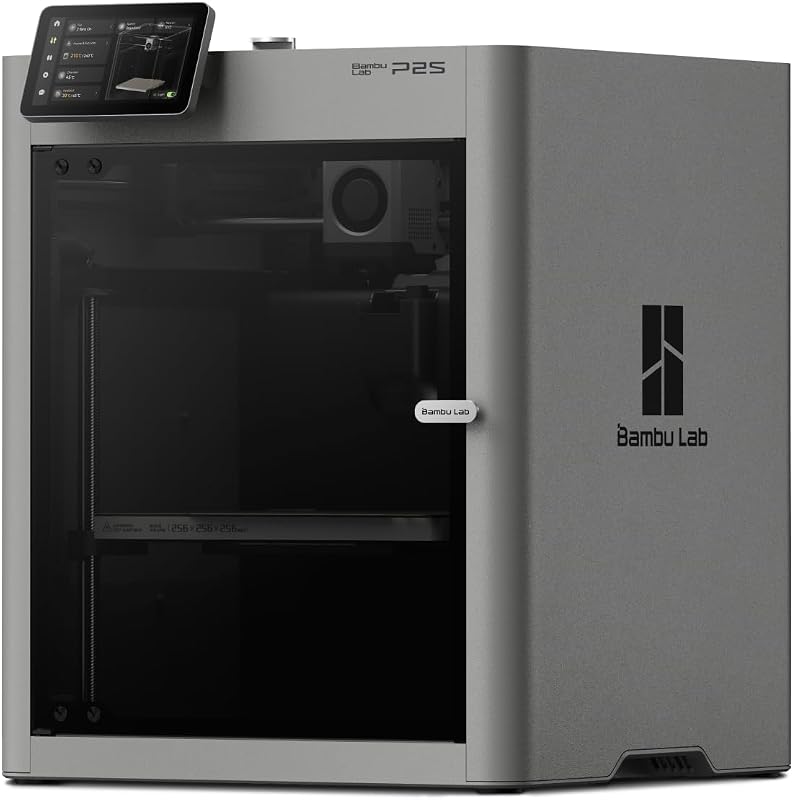
Best for: Engineers focusing exclusively on single-material structural parts
Pros
- Blazing 600 millimeter per second output
- Maintains 50 °C chamber with carbon filtration
- Active flowrate compensation and quick-swap nozzle
Cons
- Cannot print multi-color out of the box
- Combo package required for multi-filament feeding
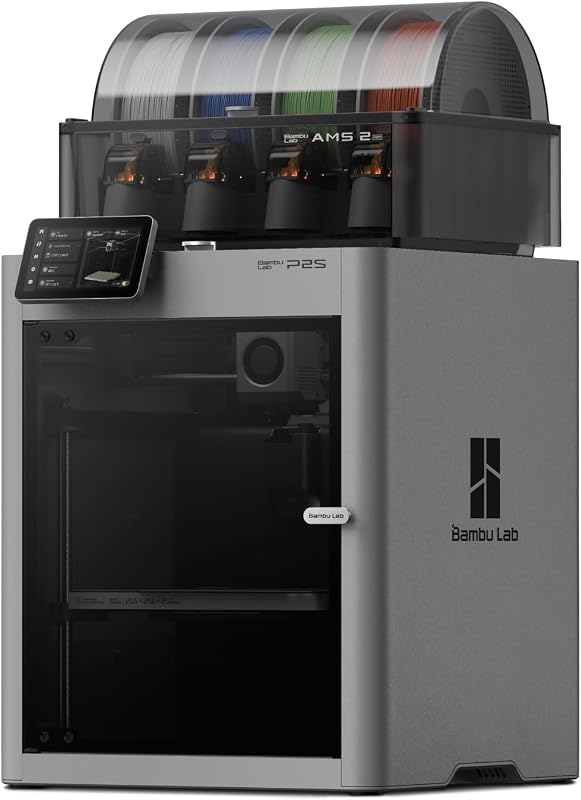
Best for: Home offices needing clean air and filament drying
Pros
- Rapid 600 millimeter per second speed
- Chamber carbon filter and airflow management
- AMS 2 Pro dries filament at 65 °C
Cons
- Requires large 22-inch desk space
- Tied to Windows 10 and smartphone ecosystem
Equipped with advanced thermal controls and motion hardware, the Bambu Lab P2S Combo advances the enclosed lineup for demanding domestic workstations. The machine measures 18 inches deep, 22 inches wide, and 18 inches high, weighing 46.3 pounds with a grey finish. It reaches speeds up to 600 mm/s, utilizing a PMSM Servo Extruder and Active Flowrate Compensation to maintain clean corner geometry and uniform layer deposition. Setup takes approximately 15 minutes, supported by automatic calibration, AI failure detection, and quick-swap nozzles.
Filament conditioning and workspace air management are core priorities in this design. The included AMS 2 Pro enables multi-color and multi-material feeding while integrating built-in filament drying up to 65 °C, protecting hygroscopic materials from moisture contamination. At the same time, the Adaptive Airflow System balances chamber temperature—holding up to 50 °C for technical plastics—while directing exhaust through a carbon filter. Workflow control operates across Windows 10 and smartphone apps through Bambu Studio and Bambu Handy, tapping into MakerWorld models.
The P2S Combo is ideal for home offices and shared spaces where air filtration, low maintenance, and continuous multi-spool readiness are critical. Its automated monitoring catches mistakes early, making it reliable for users running lengthy unattended prints. It gives way to simpler open units like the A1 when a lightweight, budget-conscious footprint is preferred over an enclosed, heated build chamber.
Bambu Lab A1 3D Printer Multi-Color Printing with AMS lite
Check price on Amazon 4.2 out of 5 — average from Amazon buyers

Best for: Beginners and kids wanting quiet desktop printing
Pros
- Quiet printing with simplified touchscreen
- Full-auto calibration and 1-clip nozzle
- Lightweight 10-kilogram open frame
Cons
- Multi-color requires purchasing separate AMS lite
- Lacks enclosed chamber for technical materials
The Bambu Lab A1 3D Printer delivers an accessible, open-bed architecture tailored for desks, craft corners, and living areas. Built using hardened steel, stainless steel, and extruded aluminum, it presents a 10-kilogram footprint measuring 21.76 inches deep, 20.83 inches wide, and 12.87 inches high. It attains an acceleration rate of 10,000 mm/s², relying on an active flow rate compensation algorithm to calibrate extrusion pressure on the fly for consistent surface finishes.
Convenience and quiet operation stand out in the listing specifications. The machine features full-auto calibration that handles Z-offset calculations and bed leveling automatically before each job. A 1-Clip quick-swap nozzle mechanism allows users to change hotends without tools, while a simplified touchscreen interface guides daily operation. The listing specifically notes that the Bambu Lab A1 is designed for easy and quiet printing for beginners and kids. Multi-color printing is possible, but requires an AMS lite unit, which is not included in this standalone base package.
This model is best suited for students, hobbyists, and classroom environments that focus on visual models and standard decorative filaments. Its open design keeps mechanical components accessible for learning and adjustments. It cedes ground to the P1S or P2S platforms whenever a user plans to extrude high-temperature or odor-producing materials that require an enclosed, filtered chamber.
Bambu Lab P2S 3D Printer The Bambu Lab P2S 3D printer prints up to 600 mm/s while maintaining
Check price on Amazon 4.1 out of 5 — average from Amazon buyers
The standalone Bambu Lab P2S 3D Printer provides the high-speed motion system and thermal enclosure of the P2S platform without bundling the multi-color feeding unit. It measures 18 inches deep, 21 inches wide, and 18 inches high, weighing 38.9 pounds. Driven by a PMSM Servo Extruder, it achieves print speeds up to 600 mm/s with active flowrate compensation. The machine is ready to print in 15 minutes, featuring automatic calibration, quick-swap nozzles, and AI failure detection.
Enclosure management matches the premium combo variant. The Adaptive Airflow System regulates internal temperatures, retaining up to 50 °C inside the build volume to prevent deformation when printing engineering-grade plastics. An onboard carbon filter scrubs exhaust air to maintain a cleaner working environment. The manufacturer listing explicitly notes that this standalone P2S does not support multi-color printing on its own; running multiple filaments requires upgrading to the combo package or adding an external material unit.
This configuration fits engineering students, functional prototypers, and workshop fabricators who specialize in single-material structural prints and do not need multi-color decorative transitions. By avoiding the overhead of extra spools, it provides an enclosed workspace at a leaner physical desk depth. It gives way to the P2S Combo when multi-filament assemblies or integrated spool drying are essential requirements.
Bambu Lab PLA 3D Printer Filament Elevate your 3D printing with Bambu Lab's PLA filament
Check price on Amazon 4.2 out of 5 — average from Amazon buyers
Best for: Everyday prototyping with automated slicer material setup
Pros
- Integrated RFID automatically loads print parameters
- Strict 0.03 millimeter diameter accuracy
- Environmentally friendly reusable spool system
Cons
- Standard PLA lacks high heat resistance
- Restricted to 1.75 millimeter diameter setups
Material quality dictates the success of high-speed desktop fabrication, and Bambu Lab PLA 3D Printer Filament is engineered to match the rapid feeding mechanisms of modern toolheads. Supplied as a 1 kg spool in Jade White, this 1.75 mm polylactic acid filament maintains a manufacturing dimensional accuracy of +/- 0.03 mm. The listing notes an extrusion profile optimized to prevent clogs, bubbles, and tangling during sustained high-speed operations.
Automation is deeply integrated through an embedded RFID chip. When loaded into a compatible feeder, Bambu Studio reads the tag and automatically applies the correct print temperatures, speed profiles, and retraction settings without manual adjustments. The material formula emphasizes toughness, tensile strength, and clean aesthetics for display or prototyping. Furthermore, the spool itself is reusable, reducing plastic waste when purchasing core refills. When sourcing reliable 3d printer filament bambu lab options, this material provides predictable surface finishes.
This filament suits anyone running standard architectural models, decorative prints, or mechanical prototypes that do not endure extreme mechanical stress or high temperatures. It integrates directly with the brand’s multi-material systems, feeding smoothly through narrow PTFE tubes. It steps aside when parts require the thermal resistance of ABS or the elasticity of TPU.
High-Performance 3D Printer by Bambu Lab Bypass for Soft or Brittle Materials
Check price on Amazon 4.6 out of 5 — average from Amazon buyers
Best for: Advanced creators requiring active high-temperature moisture removal
Pros
- Active 85 °C electro-magnetic air drying
- Supports up to 24 colors with multi-material bypass
- Brushless servo motor for smooth extrusion
Cons
- Requires PC or laptop for file processing
- Specialized accessory module rather than standalone printer
Listed as the High-Performance 3D Printer by Bambu Lab, this specialized hardware unit (designated in listing details as the AMS HT) operates as a high-capacity multi-material conditioning and delivery station. Constructed from durable PC/PA materials, the module weighs 1.21 kg and interfaces with laptops or personal computers via STL and OBJ file workflows. It integrates an 85 °C active air vent drying mechanism powered by an electro-magnetic air vent to keep hygroscopic filaments dry.
The unit supports advanced printing workflows, handling up to 24 colors across multiple materials. Material feeding is managed by an internal brushless servo motor, which maintains smooth, consistent tension. A dedicated material bypass outlet accommodates soft or brittle filaments that typically break in traditional tight-radius multi-material lines. It also includes an automatic rotating drying mechanism, an RFID auto-match sensor for official filaments, and an airtight internal storage seal.
This specialized device is aimed at advanced creators, industrial labs, and workshop power users who work with technical polymers like nylon, polycarbonate, or soluble supports requiring active high-temperature moisture removal. It provides a level of conditioning that standard passive spool holders cannot achieve. It gives way to base feeders like the standard AMS or AMS lite when a user only works with standard, ambient-stable PLA filaments.
Matching a Model to Your Setup
- Shared Home Study or Bedroom: Choose the Bambu Lab A1 3D Printer for its quiet motion components, open accessibility, and straightforward touchscreen setup.
- Basement or Garage Workshop for Functional Parts: Pick the Bambu Lab P1S Combo to utilize its enclosed metal frame and multi-color AMS unit when running odor-prone ABS or ASA.
- Dedicated Technical Office Needing Air Scrubbing: Select the Bambu Lab P2S Combo for its 600 mm/s speed, 65 °C spool drying, and built-in carbon filtration.
- Engineering Prototyper Focused on Single Polymers: Opt for the Bambu Lab P2S 3D Printer to benefit from a 50 °C heated chamber without the desktop clutter of multi-material feeders.
- High-Capacity Technical Lab Handling Moisture-Sensitive Spools: Deploy the High-Performance 3D Printer by Bambu Lab to access 85 °C active drying and up to 24 color channels.
- Standard Daily Modeling Bench: Keep a spool of Bambu Lab PLA 3D Printer Filament on hand for automated RFID parameter matching and zero-clog daily printing.
Before You Buy
Examining the manufacturer listings reveals several technical boundary lines that shoppers must plan around. The product specifications do not list exact cubic millimeter build volumes for the P1S, P2S, or A1, requiring buyers to verify precise physical clearance on their workbenches. Desktop space is particularly critical: enclosed machines like the P1S Combo and P2S Combo demand substantial clearance, measuring over 21 to 23 inches in width and weighing more than 46 pounds. Reviewing a detailed bambu lab printer comparison shows that while the standalone P2S and A1 units are capable of multi-material workflows, their listings confirm that multi-color printing is impossible out of the box without purchasing companion feeder modules separately.
Material compatibility also dictates workspace safety and ventilation. The listing for the P1S Combo explicitly notes that carbon and glass fiber reinforced polymers are not recommended, meaning composite fabricators will need alternative hardware configurations. Furthermore, while the P2S platform integrates a carbon filter to mitigate emissions during chamber heating up to 50 °C, open machines like the A1 have no enclosed chamber or filtration, making them unsuitable for running toxic or warping-prone engineering materials indoors. Checking your filament requirements beforehand makes it clear which bambu lab printer to buy for your room setup.
FAQ
Which model is the most practical choice for beginners and family use?
The Bambu Lab A1 is explicitly listed as a ready-to-use printer suited for beginners and kids. It provides full-auto calibration, a 1-Clip quick-swap nozzle, and a quiet operating profile that integrates smoothly into domestic living areas without complex enclosure management.
Can the standalone Bambu Lab P2S print in multi-color out of the box?
No. The product listing states clearly that the standalone P2S does not support multi-color printing by itself. Unlocking multi-color capability requires purchasing the Combo package or adding an external AMS 2 Pro unit.
What filaments can be safely used on the Bambu Lab P1S Combo?
The listing identifies PLA, PETG, TPU, PVA, PET, ABS, and ASA as ideal filaments, and notes capability with PA and PC. However, carbon fiber and glass fiber reinforced polymers are explicitly not recommended for this machine.
How does the RFID feature on official Bambu Lab PLA filament function?
The filament spool features an integrated RFID chip that compatible feeding systems detect automatically. Once recognized, the slicing software (Bambu Studio) applies optimized printing parameters, temperature thresholds, and material settings without manual configuration.
What operating systems and devices work with the P2S series printers?
The manufacturer listings specify compatibility with Windows 10 personal computers and smartphones. Users manage remote print jobs, AI detection monitoring, and MakerWorld model slicing using Bambu Studio and the Bambu Handy application.